

27 February 2026

Located between Cameroon and South Sudan, the Central African Republic (CAR) is a country with a rich culture and natural beauty. However, providing reliable broadband communications and Internet connectivity throughout this landlocked country, and between the CAR and the rest of the world, has been challenging for the country’s social and economic development.
Prior to 2017, Orange CAR, one of the largest communications providers serving the CAR, found that delivering reliable services to its customers was problematic. At that time, 2G and 3G mobile services were the norm in the country, and 4G had not yet been deployed. Approximately 2 million residents – just 38% of the population – had mobile service, with 3G penetration accounting for about 60%, with 2G serving the remainder. Only a small fraction – 11% or approximately 600,000 residents – had Internet access, with an average download speed of 22.55Mbps on fixed connections. Orange CAR was able to address these problems and accelerate the deployment of services to the CAR by making use of SES’s multi-orbit network of MEO and GEO satellites.
Read the full article16 December 2025
In its push to become a cashless economy by 2024, the Government of Rwanda has made heavy investments in digital infrastructure, and mobile money swiftly became one of the nation’s go-to channels for transactions. During the COVID-19 pandemic, that shift was even more dramatic: mobile money transaction values soared, jumping from RWF 3 trillion in 2019 to RWF 10 trillion in 2021.
But then growth began to plateau. Despite what many believed was good overall network coverage, a closer look revealed a major barrier to reaching their digital-economy goals: poor connectivity, especially outside urban areas. In rural zones and small towns, network reliability and capacity issues were undermining efforts to drive widespread adoption of digital payments.
Read the full article
16 December 2025

As demand for fibre-to-the-home (FTTH) networks surged across South Africa, engineering consultancy EES Live (Pty) Ltd found itself wrestling with increasingly complex design workloads. Traditional design tools — a patchwork of desktop GIS software, static maps, spreadsheets, and manually assembled bills of materials — were slowing projects down and creating significant room for costly errors.
Engineers regularly had to switch between different applications to map routes, validate addresses, assign splice points, calculate cable lengths, and prepare construction documents. Because none of these systems talked to each other, the team struggled with version control issues, inconsistent datasets, and long feedback loops. Every project required re-building documentation from scratch and repeatedly verifying that the design still aligned with real customer locations and actual field conditions. As the firm’s client base expanded and deadlines tightened, the risk of rework — or, worse, misaligned fibre builds — became increasingly problematic.
Read the full article10 December 2025
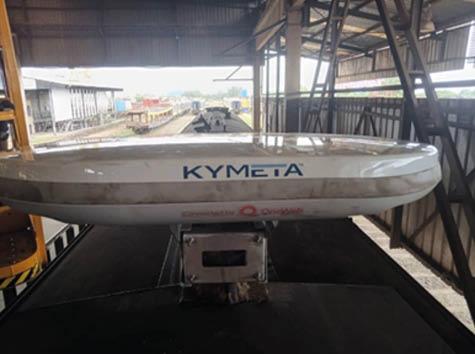
In a historic breakthrough for connectivity across the African continent, Airtel Africa has successfully demonstrated high-speed satellite internet on a moving train traversing sub-Saharan Africa’s challenging terrain.
Rail transport has long been a vital lifeline for sub-Saharan Africa, facilitating the movement of millions of tonnes of freight and hundreds of thousands of passengers annually. However, vast sections of these extensive rail lines have historically been disconnected from modern communication networks, hindering operational efficiency and passenger experience. With this successful satellite trial, that disconnect is now being bridged.
Read the full article