
10 December 2025

Gerrit Nagelhout,
COO, Preseem
Given the rapid growth of fixed wireless access across African markets, what are the top three operational challenges you see with an ISP rolling out fixed wireless access (FWA) in Africa?
The first big challenge is expertise — particularly in RF. It’s a complex, niche technology, so finding and training the right people can be tough. You might hire a few engineers who speak the language, but your wider support team often doesn’t have that same background. Tier-one support staff are usually great with people, not networking, so dealing with RF-heavy tickets is hard.
That’s where Preseem helps. We make it easier for support teams to understand what’s going on without needing deep RF expertise. We convert complex RF metrics into simple, colour-coded scores from one to ten. That cuts onboarding time and training needs dramatically. We also harmonise data from different vendors, so ISPs can view multi-vendor networks in one place.
The second challenge is maintaining best practices. It’s easy to make an access point and a few CPEs work — it’s much harder to make them work well and consistently. If you don’t start with solid installation practices, you end up wasting capital on an inefficient network. Poor RF connections don’t just hurt one client — they degrade the access point’s overall efficiency. We give operators data that objectively shows which installations are good and which need improvement.
And the third challenge is sustainability. Early on, if you’re the only ISP in a new area, you can get away with some inefficiencies. Customers are just happy to have internet. But as soon as competition appears, you’ll feel the pain. Getting your network fundamentals right from day one is essential.
Preseem emphasises the shift from reactive to proactive network management. What practical steps should ISPs take to implement that?
Start by ensuring every CPE has a clean connection. Our RF score — rated zero to ten and colour-coded — makes it easy to spot problem areas. You can quickly see whether issues affect all CPEs on an access point or just a few. From there, set measurable goals for your team, such as improving a certain percentage of scores each quarter.
Next, monitor access point capacity. Overloaded APs cause latency spikes, buffering, and poor user experience. Preseem identifies which APs are full, how many subscribers they can still handle, and which clients are consuming too much airtime. That lets you take action before customers notice issues.
Interference usually isn’t bad if you’re the only WISP in an area — unless you’re causing it yourself. But once competition increases, noise becomes a real problem. Again, our RF score flags this early. It tracks factors like RSSI, noise, and stability, so if the score drops, you know something’s wrong before users start complaining. It’s a single metric that saves you from digging through ten others.
Capacity management is often the biggest business problem for wireless ISPs, especially in dense or fast-growing areas. What are the best practices for access point capacity management?
Capacity management comes down to two things: contention and airtime.
Too many clients on one access point (contention) means it spends all its time switching between them instead of doing useful work. You need to keep that below a certain threshold.
Then there’s airtime — how efficiently your APs handle traffic. A bad RF connection uses far more airtime for each bit transferred, reducing the total throughput for everyone. Clean connections maximise both bandwidth and efficiency.
Preseem helps by showing how many subscribers you can safely add and by tracking latency in real time. We measure latency for every subscriber and aggregate that into daily scores per access point. If all latencies spike during peak hours, that AP is congested, and you know exactly where to act.
Do you approach greenfield networks differently from established ones?
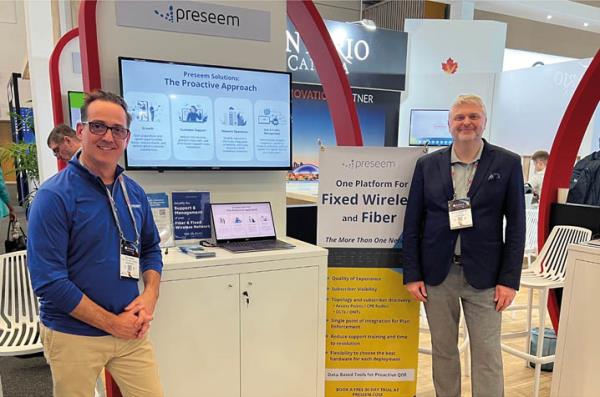
We’re complementary to existing monitoring systems. Whether it’s a new or mature network, we connect to whatever access points are in use and start showing data immediately.
For new deployments, the focus should be on doing those first installs right. Poor early installs might not hurt much now, but they’ll cap how many subscribers you can add later. Established networks, on the other hand, benefit from our insights into performance optimisation and capacity balancing.
Many African ISPs run mixed infrastructures — fixed wireless, fibre, satellite — and use multiple vendor systems. How important is vendor-agnostic visibility in such an environment?
It’s crucial. Each vendor does things differently, so onboarding new staff takes time — they have to learn Cambium, MikroTik, Ubiquiti, Mimosa, Huawei, ZTE, and others. We normalise all that into a single, unified view, dramatically cutting onboarding time and giving teams confidence to handle support tickets.
Even for engineers, checking multiple systems is painful. Preseem centralises that workflow, improving efficiency and allowing teams to act proactively across mixed technologies.
With subscriber expectations rising — streaming, remote work, heavy mobile use — how can ISPs manage expectations and maintain satisfaction without overspending?
It all starts with managing plan speeds intelligently. A default rate limiter is a blunt instrument — it technically enforces speeds but often creates lag and frustration. Our “experience-optimised” shapers are smarter: even at max plan speed, users get smoother, lower-latency performance.
We’ve had customers see their call volumes drop dramatically after activating our shapers. Once latency is reduced at that level, we can pinpoint deeper network issues, like overloaded backhauls or specific access points, using our inline experience data. If an AP is overloaded, our automatic capacity management tool limits throughput intelligently to prevent buffering and preserve user experience.
The results are immediate — fewer support calls, fewer truck rolls, and happier customers. That directly reduces operational costs. Being proactive also cuts churn, since many unhappy customers don’t complain — they just leave.
On the revenue side, better data helps identify upsell opportunities. If a customer consistently maxes out their plan but has a strong link and available capacity, you can confidently offer a higher plan. That drives ARPU growth while maintaining a positive experience.
Given Africa’s unique challenges — spectrum constraints, power reliability, and diverse terrain — what trends will most influence fixed wireless operations in the next few years?
More spectrum availability will be a game-changer. The 6GHz and 4GHz bands are under review, and dynamic frequency allocation looks promising. As 5GHz gets congested, those new bands will really help. Preseem will support operators by showing which APs are busiest and which clients should move to the new spectrum first.
We’re also watching Starlink. It won’t replace all ISPs, but it raises the bar for customer expectations. ISPs need to build resilient, high-quality networks now to stay competitive.
Africa is our second-largest market after the US, and it’s growing fast. The opportunities in South Africa are huge, and we’re seeing early traction in Kenya and Nigeria too. Markets there are developing quickly, and as ARPU levels and stability improve, we see strong potential across the continent.
Preseem’s mission has always been to help regional and independent ISPs compete with the big players — and Africa’s growth story fits that perfectly.